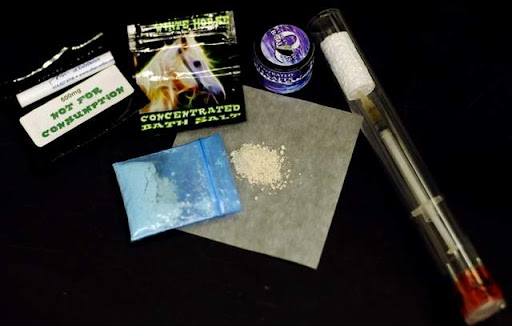
 Middlesex County Prosecutor's Office has announced that three smoke shops in New Brunswick and a gas station in East Brunswick were raided and charged in the sale of illegal drugs. According to the Prosecutor's Office, the raids began on Aug. 2 after four months of investigative work and netted the following arrests: Jarnail Sandhu, 25, of Sayreville, owner of the Shell gas station located at 1010 Route 18 in East Brunswick, was arrested and charged with distribution of bath salts and synthetic marijuana; possession of bath salts and synthetic marijuana and possession of drug paraphernalia. He was jailed with bail set at $100,000, with no 10 percent option. Sandhu's mother, Charanjit K. Sandhu, 56, of Nanuet, N.Y., was also arrested and released on her own recognizance. She faces the same charges as her son. Ayman S. Al-Nsairat, 40, of East Brunswick, owner of the Amsterdam Smoke Shop, 29 Easton Ave. in New Brunswick. He was charged with possession of toxic chemicals and possession of drug paraphernalia, and was released on his own recognizance. Maria M. Almanzar, 20, of Union City at the Amsterdam Smoke Shop. She was charged with possession of toxic chemicals and possession of drug paraphernalia, and distribution of toxic chemicals, and was released on her own recognizance. Lukasz M. Poplawski, 21, of Staten Island, N.Y. at the Amsterdam Smoke Shop. He was charged with possession of toxic chemicals and possession of drug paraphernalia, and distribution of toxic chemicals, and was released on his own recognizance. Ranmanjeet K. Dhillon, 24, of Woodbridge, at the Jamaican Discount Smoke Shop at 38-A Easton Ave. in New Brunswick. Dhillon was charged with possession and distribution of toxic chemicals and possession of drug paraphernalia, and was released on her own recognizance. Additionally, the Jamaican Smoke Shop at 40 Easton Ave. in New Brunswick was also raided, and "Some illegal substances and drug paraphernalia were seized," according to the Prosecutor's office. No arrests were made at that location. Bath Salts are mix of chemicals that mimic the effects of cocaine and methamphetamines and were banned earlier this year. 6,547 bags, jars and vials containing synthetic marijuana and bath salts were also seized by police during the investigation, marked for sale for between $20 to $30 each, according to the Prosecutor's Office. Police also seized 2,914 pipes, bongs and hookahs, 193 digital scales, 357 canisters containing nitrous oxide, 13 imitation handguns used to fire blanks, and 46 containers designed to conceal illicit drugs, according to the Prosecutor's Office. Packaging material, grinders, cigars and rolling papers, "All identified as products used to prepare and help sell the illicit drugs," according to the Prosecutor's Office. $25,145 in cash from the sales of the illegal drugs was also seized. More than $163,000 in synthetic Marijuana and bath salts were seized. Members of the Middlesex County Prosecutor’s Gangs, Guns and Drugs Task Force are handling the investigation, assisted by police in New Brunswick, East Brunswick and Sayreville, according to the Prosecutor's Office
 In September 2008, 11 decapitated bodies were discovered in Mexico’s Yucatan peninsula. When police arrested the killers, they found an altar in their home dedicated to Santa Muerte – the patron saint of death for Mexican drug cartels. One year later, an illegal immigrant called Jorge Flores Rojas was arrested in North Carolina for running a sex ring. He, too, had built a shrine in his east Charlotte apartment to Santa Muerte. Flores forced his girls to have sex with as many as 20 men a day while he knelt in his living room praying to the skeletal figure of death. In August 2011, the Mexican army stumbled upon a tunnel that ran right under the US border for 300 metres. It was six feet high and equipped with lights and ventilation. It also housed – you guessed it – an altar to Santa Muerte. Europeans complain mightily that Muslim immigration has introduced fundamentalism to their secular continent. Yet they tend to look upon Middle America’s fear of illegal Hispanic immigration with contempt, as if its paranoia was motivated entirely by racism. Reporting on new legislation designed to drive illegal immigrants out of the Deep South, The Guardian’s Paul Harris writes that it heralds, “The prospect of a new Jim Crow era – the time when segregation was law – across a vast swath of the old Confederacy. [The legislation] will ostracise and terrorise a vulnerable Hispanic minority with few legal rights.” Indeed it will, and that is a tragedy. But the debate about illegal immigration isn’t just about competition over jobs or lingering white racism. Many Americans share the European fear that mass migration is subverting their democratic culture from within. In the same way that exotic cells of Jihadists have established themselves in London and Paris, criminal gangs motivated by bloodlust and kinky spiritualism have been found living in the suburbs of Boston and Atlanta. One of its many manifestations is the cult of Santa Meurte. Santa Muerte is part Virgin Mary, part folk demon. The image of a cloaked saint wielding a scythe is supposed to offer those who venerate it spiritual protection. Offerings come in the form of flowers, alcohol, sweets and tobacco. Contraband can be used to invoke protection from the police. For the poor of Mexico – a nation torn between extremes of wealth and injustice – Santa Muerte is a very pragmatic saint. Like the gang leaders who offer hard cash in return for allegiance, she provides material blessings that the Catholic Church can no longer afford to bestow. Tens of thousands of Mexicans living in America venerate Santa Muerte and have no association with crime. Nor is the cult purely ethnic: in North California, the Santisima Muerte Chapel of Perpetual Pilgrimage is tended by a woman of Dutch-American descent. But the prevalence of Santa Muerte imagery among drug traffickers injects an interesting cultural dimension to the debate over illegal immigration. It accentuates American fears that the drug war in Mexico is turning into an invasion of the USA by antidemocratic fanatics. The Mexican conflict has claimed 35,000 lives since it began in 2006. Recently, the violence has spilled over the border and spread throughout the US along narcotics routes that stretch from Arizona to New York. The warring cartels are bound by a perverse ideology, with Santa Muerte as a unifying icon that terrifies opponents into submission. The gang known as Los Zetas marks its territory by mounting severed heads on poles or hanging dead bodies from bridges. Its members are family men who regularly go to church. A splinter group, called La Familia, is fronted by a fellow called El Mas Loco (The Craziest One). Loco has published his own bible, a confused mix of peasant Marxism and passages culled from American self-help books. The goal of these groups is to undermine democracy and govern autonomous secret societies through family, blood and religion. It’s a global trend. The Lord’s Resistance Army that slaughtered and raped its way across Uganda from 1987 to 2007 was led by a man who claimed to channel the Holy Spirit. Perhaps the culprit behind this apocalyptic criminality was the death of Communism, which deprived thugs and thieves of a secular ideology to justify their actions. Organisations like FARC and Real IRA converted overnight to pushing drugs. But in Mexico, family and religion filled the vacuum left by the failure of socialism. Whatever its origins, the spread of the cult of Santa Muerde reflects the fact that the debate over immigration in the US is about more than economics. Sadly, Mexicans seeking work get caught in this existential drama and are either swallowed up into the gangs or demonised in the US for crimes they have not committed. Nevertheless, Americans of every ethnicity are legitimately concerned about their country being poisoned by a criminal subculture that blends political corruption with ritualised murder. Europeans should not be so quick to judge their transatlantic friends. Americans face a vicious threat of their own.
 The documents revealing the cosy relationship between top British and Libyan intelligence officials are embarrassing not just because they confirm Britain's rendition of Islamist terror suspects, including Abdel Hakim Belhadj, the Transitional National Council's new security commander in Tripoli, but also because they lend credence to Britain's reputation as a slippery operator in the Middle East. David Cameron's support for the TNC was meant to gain souk cred by tying Britain's banner to the spirit of the Arab Spring. Cameron has said the new documents should be examined by the independent Detainee Inquiry, chaired by Sir Peter Gibson. They show how keen Tony Blair was to bring Gaddafi into the fold following Saddam Hussein's fall in April 2003 and to trade an end to Libya's pariah status in return for help in the war against terrorism. There was little wrong with that. What is sickening is the extent to which Britain sought to ingratiate itself by delivering up Gaddafi's opponents. No less disturbing is the manner in which Britain's cosying up to Gaddafi has been represented as a mistake by misguided individuals, for which institutions such as the London School of Economics have suffered. Perhaps the most fascinating new document was sent on March 18, 2004 to Musa Kusa, head of Libyan intelligence, by Mark Allen, MI6's director of counter-terrorism, who crowed about Belhadj's rendition while arranging a forthcoming visit by Blair to Libya. A week later Gaddafi welcomed the British PM in his Tripoli tent (as requested by Allen for publicity reasons). It is difficult to say who was the greater showman: the unctuous Blair or Gaddafi joking how his Third Universal Theory, the basis of his Green Book, paved the way for Blair's Third Way politics. Within two months, Allen was pipped as the next MI6 head by John Scarlett, who, two years earlier, as chief of the Joint Intelligence Committee, had backed Blair's argument that Saddam had dangerous weapons of mass destruction. Allen left the SIS shortly afterwards. For Middle East watchers, an interesting outcome has been these glimpses of intelligence machinations in this most secretive of regions. A Le Carré of the al Qaeda conflict will surely follow. It is Cameron who now has to deal with the practical consequences. The ultimate fate of Gaddafi and his family is out of his hands. But Britain has tough decisions to make about other players, including Musa Kusa, who defected from Libya in March, came to Britain, and was last heard of in a Qatar hotel. In 1980 he was expelled from Britain for advocating the murder of Libyan dissidents. For this and his wider role in Libyan terrorism, many powerful voices argue that he should be tried in Britain. But, even at this stage, it may be that he has too much to reveal. More immediately, the Prime Minister needs to assess the role of former Islamists such as Belhadj in the new regime and take appropriate measures. It will not be enough to kick the rendition issue into the long grass by referring it to the Gibson inquiry, which has yet to begin its work. If David Cameron hoped for an easy ride in post-Gaddafi Libya, these papers have disabused him of that notion.